
A strategic comparison for hardware founders deciding how to de-risk their launch before spending on tooling, inventory, or a crowdfunding campaign.
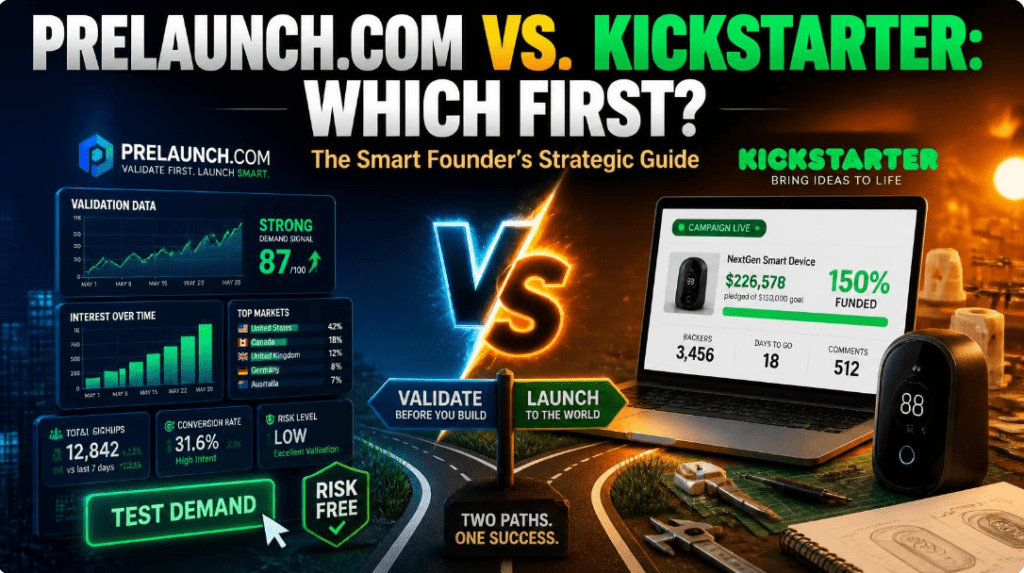
Table of Contents
Introduction: The Real Question Behind Prelaunch.com vs. Kickstarter
Every hardware founder eventually faces the same fork in the road: Prelaunch.com vs. Kickstarter — which platform should come first? It is a fair question, because the decision determines whether you spend the next twelve months validating demand with data, or betting tens of thousands of dollars on tooling, injection molds, and paid marketing before you know if anyone will actually buy.
For hardware startups, this is not a minor operational choice. Unlike software, hardware carries physical, irreversible costs: mold fees, minimum order quantities from manufacturers, warehousing, and shipping logistics. A founder who commits to production before confirming real buyer intent risks the single most common cause of hardware startup failure — building a well-engineered product that the market never asked for. Understanding where each platform fits in the launch journey is therefore not a branding exercise; it is a capital-allocation decision.
Understanding What Each Platform Actually Does
Kickstarter: The Pinnacle of Crowdfunding and Community
Kickstarter remains the most recognized name in crowdfunding, and for good reason. It offers founders access to a large, engaged community of early adopters who are culturally primed to back new hardware ideas. A well-run campaign can generate meaningful capital, public validation, and press attention in a matter of weeks.
That strength comes with a structural trade-off. Kickstarter is optimized for founders who already have a reasonably finished prototype, a persuasive campaign video, and — increasingly — a paid traffic budget to drive pledges during the critical first 48 hours. Because pledges are public and time-boxed, an underperforming launch is also a visible one. If the underlying product-market fit has not been tested beforehand, the campaign itself becomes the first real test, with the founder’s reputation, remaining capital, and manufacturing relationships on the line.
Prelaunch.com: A Validation Layer Built on Buyer-Intent Data
Prelaunch.com is not designed to replace a crowdfunding campaign; it is designed to answer the question a campaign cannot answer safely: does genuine demand exist, and at what price? Instead of asking people to pledge real money publicly, Prelaunch.com uses reservation mechanics and controlled ad testing to capture buyer-intent signals — who is interested, how price-sensitive they are, which markets respond best, and how strong the purchase intent actually is before any tooling decision is made.
This distinction is the core of the Prelaunch.com vs. Kickstarter conversation. One platform measures whether an idea deserves capital. The other platform deploys capital once that idea has already been deemed worth pursuing. Treating them as interchangeable tools misses the different jobs they were built to do.
Prelaunch Review 2026: An Expert’s Honest Look at the Product Validation Platform
Prelaunch.com vs. Kickstarter: A Side-by-Side Comparison
The table below breaks the decision down into the criteria that matter most to a hardware founder allocating limited capital and time.
| Criteria | Prelaunch.com | Kickstarter |
| Core Purpose | Demand validation. Measures real buyer intent before you commit to tooling or mass production. | Crowdfunding. Collects pledges to finance a production run once the campaign goes live. |
| Starting Cost | Low. Built for early-stage testing before major capital is spent on molds or inventory. | Low to enter, but a credible campaign usually requires a finished prototype, video production, and paid ads. |
| Primary Metric | Buyer-intent data: reservations, email capture rate, ad-to-lead conversion, price sensitivity. | Total dollars pledged and number of backers by campaign deadline. |
| Customer Data Ownership | Founder owns first-party data: emails, geography, willingness-to-pay signals. | Backer data is partially platform-mediated; founders have more limited direct access. |
| Risk Profile | Lower financial exposure. A weak signal can be discovered before manufacturing decisions are made. | Higher exposure. An underfunded or over-promised campaign can mean lost deposits, reputational damage, and fulfillment strain. |
| Best Timing in the Journey | Pre-manufacturing, idea and concept stage. | Post-validation, once demand and production readiness are established. |
Starting Cost and Financial Exposure
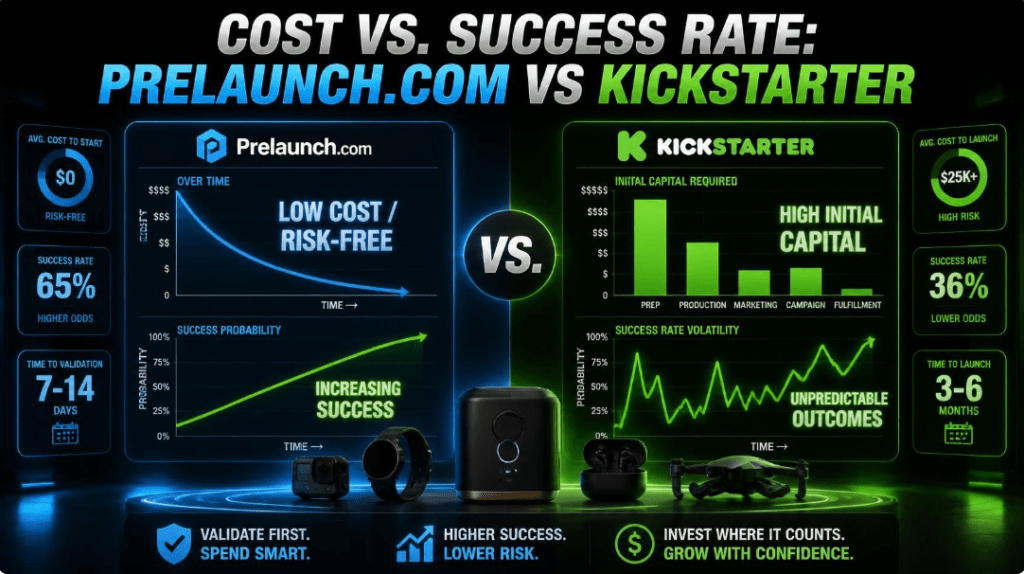
Both platforms have accessible entry points, but the real cost difference emerges downstream. A Kickstarter campaign that underperforms after a founder has already invested in a finished prototype, professional video production, and a paid-ads budget represents a sunk cost that is difficult to recover. A Prelaunch.com campaign that underperforms is, by design, cheaper information — it tells the founder to adjust the product or pricing before those larger expenses are committed.
Purpose: Validating Demand vs. Mobilizing a Crowd
This is the clearest dividing line. Prelaunch.com exists to validate demand: it answers whether the market wants this specific product, at this specific price, before manufacturing decisions lock in. Kickstarter exists to mobilize a crowd around a decision that has, in most successful cases, already been made. Neither purpose is superior in the abstract — they simply serve different points in the founder’s journey.
Control Over Customer Data
Because Prelaunch.com is built around capturing first-party buyer-intent data — emails, geography, and willingness-to-pay signals — founders retain direct ownership of that information for future marketing and product decisions. On Kickstarter, backer relationships are more closely mediated by the platform itself, which can limit how directly founders can act on the data generated during a campaign.
Risk of Failure and Its Consequences
A failed or underfunded Kickstarter campaign is a public event. It can affect a founder’s ability to raise from investors, negotiate with manufacturers, or attempt a second campaign later. A weak signal on Prelaunch.com, by contrast, is a private data point — an opportunity to pivot the product, adjust pricing, or refine positioning before any public capital commitment is made.
The Strategic Insight: Two Stages of One Funnel, Not Two Competing Choices
The most common mistake in the Prelaunch.com vs. Kickstarter debate is framing it as an either/or decision. In practice, the two platforms occupy sequential stages of the same launch funnel, and the founders who avoid the costliest hardware mistakes tend to use them in order rather than in isolation.
A more disciplined sequence looks like this:
- Stage 1 — Validate on Prelaunch.com: Test buyer intent, pricing tiers, and audience segments before committing to molds, minimum order quantities, or a full campaign production budget.
- Stage 2 — Launch on Kickstarter: Enter the crowdfunding stage with validated demand data, a tested price point, and a warmed-up list of interested buyers ready to convert into backers on day one.
This sequencing changes the entire risk profile of a hardware launch. Instead of using a Kickstarter campaign to discover whether a market exists, founders arrive at Kickstarter already knowing the answer — and use the campaign to scale a demand signal that has already been confirmed. The tens of thousands of dollars typically spent testing assumptions during a live crowdfunding campaign can instead be spent earlier, more cheaply, and more privately, on Prelaunch.com.
Conclusion: Choosing the Right Starting Point
Kickstarter and Prelaunch.com are not competitors fighting for the same use case — they are two distinct instruments for two distinct problems. Kickstarter is unmatched at mobilizing a community and financing a production run once demand is established. Prelaunch.com is built to answer the question that should come first: is this idea, at this price, something real buyers actually want?
For hardware founders who want to avoid the most expensive mistake in the industry — manufacturing a product before confirming anyone will buy it — validating on Prelaunch.com before stepping onto the Kickstarter stage is the more capital-efficient path forward.