
If you’re publishing a blog post and then manually rewriting it into a newsletter every week, you’re running two content businesses instead of one. This guide fixes that — with a specific, repeatable pipeline, not a productivity platitude.
Table of Contents
The Content Bottleneck: Why Solopreneurs Burn Out on Repurposing
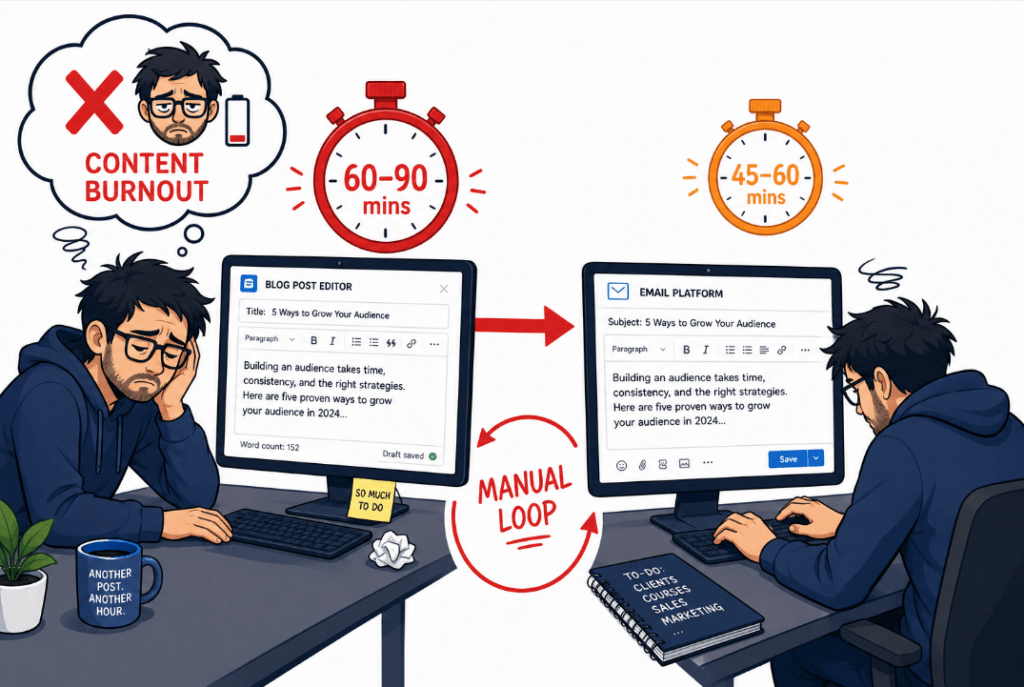
Here’s the pattern most solo operators fall into without noticing: write the blog post (60–90 minutes), then open a second document to rewrite the same ideas as an email (another 45–60 minutes), then log into the email platform to format it, check links, and schedule (15–20 minutes).
Same ideas, three separate production runs. Each channel gets treated like its own island — its own draft, its own formatting pass, its own mental context switch. None of that time produces new insight. It’s transcription labor dressed up as “content marketing.”
This is what quietly caps a solopreneur’s output. Not a lack of ideas — a lack of a system that moves one idea across channels without you manually carrying it there each time.
The fix isn’t writing faster. It’s removing the redundant production runs altogether.
The Solution: The “Write Once, Distribute Everywhere” Architecture
Think of your content operation as a pipeline, not a set of disconnected tasks. One long-form piece — your blog post — becomes the single source of truth. Everything downstream (the email digest, the social caption, the follow-up sequence) is a derivative extraction from that source, not a fresh writing project.
Jasper’s campaign structure is built for exactly this: a core piece of content plus a set of connected outputs generated from it, rather than each asset starting from a blank page. Brevo then takes that email-ready output and handles the delivery layer — templates, scheduling, list segmentation — so formatting isn’t a manual step either.
The result: one hour of focused creation produces a blog post and a newsletter, instead of two separate hours producing the same thing twice.
Jasper AI and Brevo Integration: The Step-by-Step Implementation Guide
Here’s the operational bridge, broken into three phases. Each phase has one job. Don’t skip Phase 2 to get to automation faster — an unformatted template will cost you more time weekly than it saves.
Phase 1: The AI Content Extraction (Jasper)
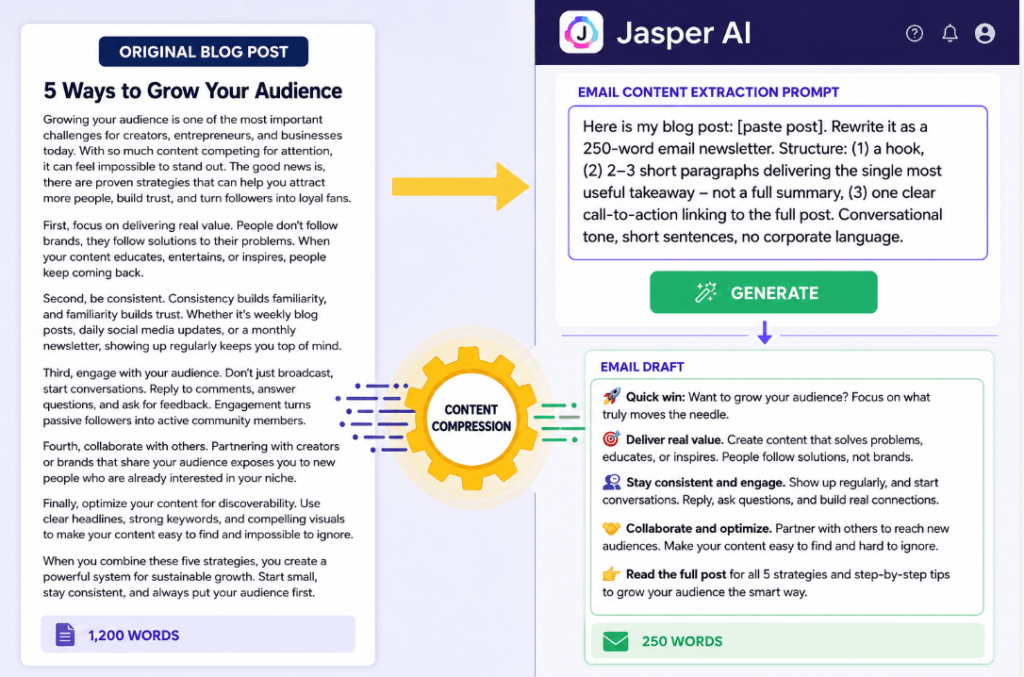
Start with your finished blog post — 1,200 to 1,500 words is the sweet spot for this extraction. Your job is to compress it, not summarize it. A summary lists what the post covered; a good email digest re-sells the single best idea in it.
Use a prompt that forces structure, not just brevity:
| “Here is my blog post: [paste post]. Rewrite it as a 250-word email newsletter. Structure: (1) a one-line hook that creates curiosity or tension, (2) 2–3 short paragraphs delivering the single most useful takeaway from the post — not a full summary, (3) one clear call-to-action linking to the full post. Conversational tone, short sentences, no corporate language, no bullet-point recap.” |
Run it once, then edit for voice — this is a draft accelerator, not a publish button. Two minutes of editing here is still faster than writing the email from scratch.
Phase 2: The Hand-off & Formatting (Brevo Setup)
Before your first send, build the template once so you never rebuild it again:
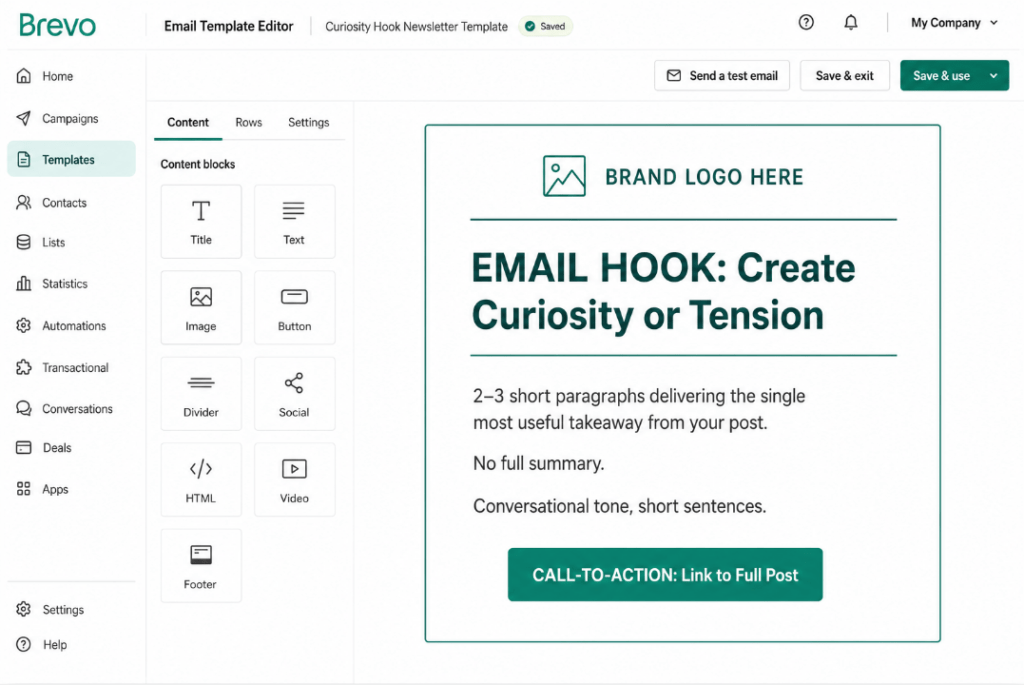
- In Brevo, go to Campaigns → Templates and create a new template (drag-and-drop editor is fine for this).
- Set your brand layout: logo header, consistent font pairing, a single accent color, and a footer with your unsubscribe and contact info.
- Build the content blocks to match the Phase 1 output structure: a headline block for the hook, a text block for the takeaway, and a button block for the CTA — pre-linked in the button style you’ll reuse every time.
- Save it as a reusable template, not a one-off campaign, so “new campaign” always starts from your branded shell instead of a blank canvas.
- Do one test send to yourself to check rendering on mobile before it goes to the full list.
This is the step most people skip when they’re excited about AI drafting speed — and it’s exactly where the weekly time savings actually get locked in. A five-minute paste-and-check beats a fifteen-minute rebuild, every week, indefinitely.
Phase 3: The Automation Bridge
With the extraction prompt and the template both standardized, the last piece is making the hand-off itself frictionless rather than fully “hands-off” — full end-to-end automation between the two tools isn’t necessary to get most of the time savings.
- Keep a standing Jasper document (or saved prompt) dedicated to email extraction, so Phase 1 is a paste-and-run action each week, not a re-explained task.
- Paste the Phase 1 output straight into your saved Brevo template’s content blocks — no reformatting, since the blocks are already built.
- Use Brevo’s scheduling (not “send now”) to lock in a consistent send day and time, decoupling the writing moment from the send moment.
- If your workflow tools support it, connect blog publication to a task or reminder trigger (e.g., via Zapier/Make) so the email step is never simply forgotten in a busy week.
The goal here is a workflow with no open decisions left in it — write the post, run the prompt, paste into the template, schedule. Every step should be a rote action, not a fresh choice.
The Solopreneur ROI: Why This Changes Your Week
Run the math on what this actually returns:
| Metric | Value |
| Time saved per week (repurposing + formatting) | ~2 hours |
| Weeks of consistent publishing per year | ~50 |
| Hours reclaimed annually | 100+ hours |
| Equivalent to | 2.5 standard work weeks |
One hundred hours is not a rounding error. It’s roughly what it takes to onboard several new clients, build a new digital product, or run a full quarter of strategic planning that usually gets postponed indefinitely because “there’s no time.”
The point isn’t that email repurposing is hard. It’s that it’s recurring, manual, and low-leverage — exactly the category of task a solo operator should be systemizing first, before optimizing anything else in the business.
Conclusion: Build the Pipeline Once, Benefit From It Every Week
The blog-to-inbox bottleneck isn’t a writing problem. It’s an architecture problem — treating one idea as three separate production jobs instead of one source feeding multiple outputs.
Jasper handles the compression from long-form to email-ready copy. Brevo handles the delivery infrastructure — template, list, schedule — so neither step requires you to start from zero. Set both up once this week, and every subsequent post takes an extra ten minutes instead of an extra hour.
READY TO BUILD YOUR CONTENT PIPELINE?
RELATED ARTICLES:
How to Train Jasper AI’s Brand Voice in 10 Minutes (So Your Content Doesn’t Sound Like a Robot)
Jasper AI vs. Copy.ai: Which AI Writing Partner Wins the Solopreneur’s Workflow Battle?
How to Automate Content Creation for Solopreneurs: The Jasper AI Blueprint