
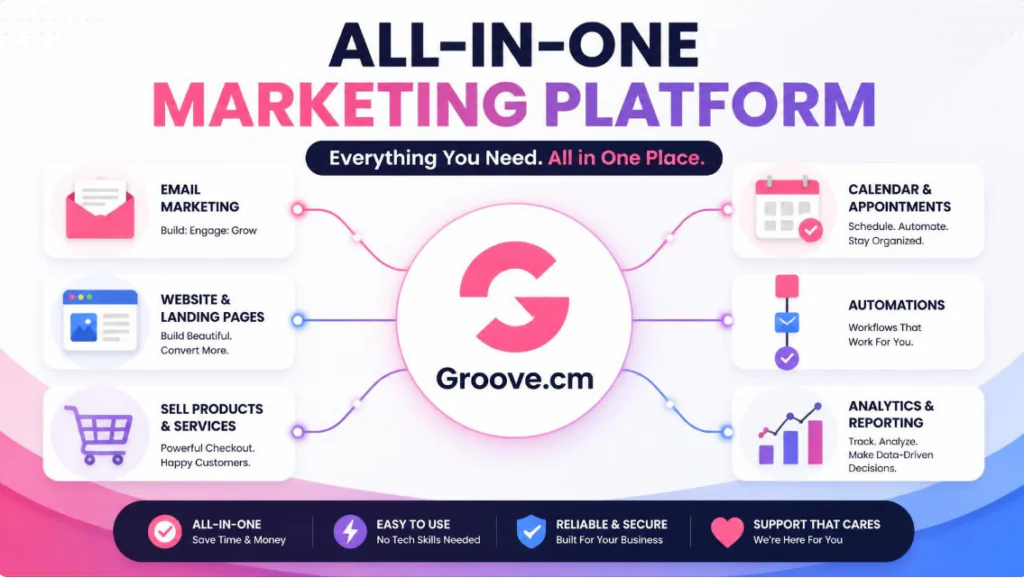
If you’ve spent any time researching marketing software, you’ve probably run into this comprehensive Groove Review. If you are looking for an honest Groove Review 2026, you’ve likely encountered their famous pitch: one platform, dozens of tools, and a free plan that supposedly never expires. That’s the promise behind Groove (formerly known as GrooveFunnels, now operating under the Groove.cm brand). It sounds almost too good — website builder, sales funnels, email marketing, e-commerce store, membership sites, affiliate management, and more, all bundled together, with an entry point that costs nothing.
But “free forever” is a marketing line, not a technical spec. In this review, we dig into what Groove actually gives you for free, what you have to pay for, how the platform has evolved since its noisy 2020 launch, and whether it deserves a place in your tech stack in 2026. We’ll look at real user feedback — the good and the genuinely frustrating — so you can make a decision based on facts rather than a sales page.
What’s Inside This Guide
A Quick History: From GrooveApps to GrooveFunnels to Groove.cm
Groove didn’t start as “Groove.” The platform was originally announced as GrooveApps, then rebranded to GrooveFunnels during its public beta launch in 2020. It was co-founded by Mike Filsaime, a long-time figure in the internet marketing space who also helped build Kartra and WebinarJam — both well-known names in the funnel-software world. Eventually, as the suite grew well beyond “funnels” into websites, e-commerce, helpdesk, scheduling, and more, the company rebranded again to Groove.cm, a name meant to reflect the platform’s broader ambitions.
This rebranding history matters for one reason: pricing and plan names have changed repeatedly over the years, and a lot of “reviews” floating around the internet are based on outdated plan structures from 2021 or 2022. If an article you’re reading still talks about a one-time “lifetime” purchase as the current standard offer, treat that information with caution — it may not reflect what’s actually on the pricing page today.
During the original beta period, Groove offered a one-time lifetime Platinum membership, priced at roughly $1,397 as a single payment or split into four payments of about $497. Lifetime deals like this are no longer available to new members, though early adopters who bought in back then generally still retain their lifetime access. The platform has since shifted toward a more conventional monthly/annual subscription model, which is the structure most new users will encounter in 2026.
What You Actually Get on the Free Plan
This is the section everyone wants answered first: can you genuinely use Groove without paying anything?
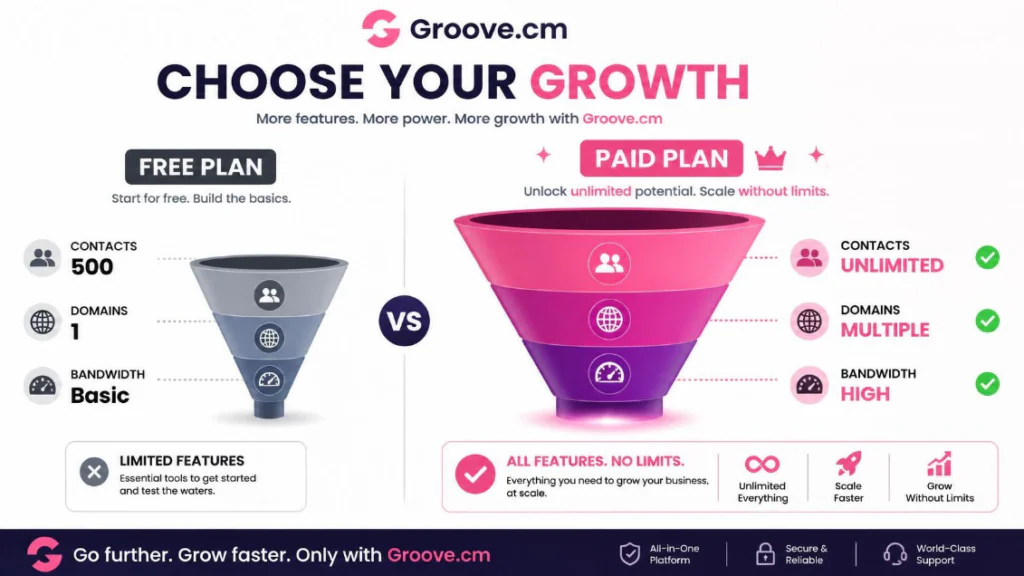
The short answer is yes — there is a free, no-credit-card-required tier, and you can use it indefinitely rather than it being a time-limited trial. On the free plan you typically get:
- A limited number of websites and funnel pages built with the GroovePages drag-and-drop editor
- Basic access to the GrooveSell checkout and order system for selling digital products
- A capped number of email contacts in GrooveMail
- Access to a free training/education area
- Limited storage and bandwidth for hosting your pages and assets
That’s a genuinely useful starting point for someone testing the waters of online business, especially someone who isn’t ready to commit a monthly budget yet. The catch — and there’s always a catch with “free forever” claims — is that the free tier is intentionally narrow. Contact limits, page limits, and bandwidth caps mean that any business with real traffic or a growing email list will hit a ceiling fairly quickly. Video hosting on the free and lower tiers also requires linking an external service like YouTube or Vimeo, since native HD video hosting (GrooveVideo) is reserved for higher-tier plans.
So is it “free forever”? Technically, yes — the account itself doesn’t expire and doesn’t require a credit card. But it’s free in the same way a freemium app is free: enough to get you hooked, not enough to actually run a serious business on. Treat it as a sandbox to evaluate the interface and workflow, not as a long-term home for a growing company.
Groove Pricing in 2026: What the Paid Plans Actually Cost
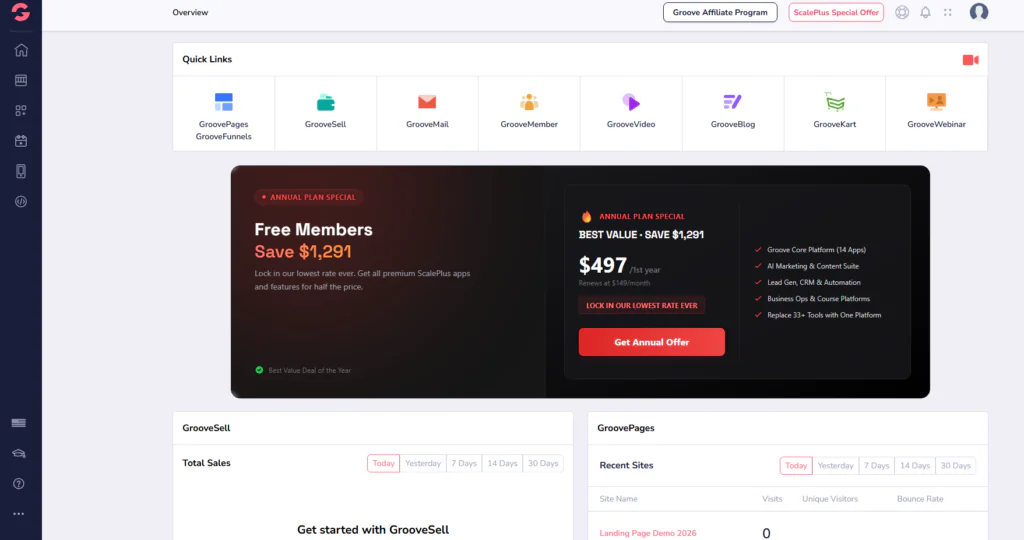
Pricing has shifted multiple times since launch, and Groove.cm has experimented with both subscription pricing and the occasional return of lifetime-style offers, so always double-check the current numbers on their site before buying. As of 2026, the general structure looks roughly like this:
Creator / Creator+ tier — aimed at solo creators and small businesses, this tier sits in the roughly $40–80/month range depending on whether you pay monthly or annually (annual plans are typically cheaper per month). It usually includes unlimited custom domains and pages, a five-figure email contact allowance, multiple payment gateway integrations, and access to core apps like GroovePages, GrooveMail, and GrooveSell.
Pro / Platinum tier — the top consumer-facing plan, generally priced higher (historically marketed around the $99/month mark for higher tiers, though exact figures shift). This unlocks essentially everything: unlimited funnels and websites, unlimited custom domains, the highest GrooveMail contact ceiling available, unlimited memberships and members, full webinar functionality (live and automated), the GrooveDesk helpdesk, GrooveCalendar scheduling, GrooveSurvey and GrooveQuiz tools, native GrooveVideo hosting with HD bandwidth and encryption, the full GrooveKart e-commerce storefront, the GroovePipe CRM, and a doubled affiliate commission rate for anyone promoting Groove itself.
Enterprise / Agency tier — custom pricing aimed at agencies and high-volume businesses, with higher email sending volume, team seats, and some white-label options, though Groove’s agency tooling is still considered less mature than purpose-built agency platforms.
One important nuance: Groove has a history of running limited-time promotions, “special” annual or semi-annual pricing, and occasionally reviving discounted lifetime-style bundles for a window of time. If you see a deeply discounted offer, it’s worth checking how long it has been live and reading recent (not three-year-old) reviews before committing, since the platform’s promotional pricing has been a recurring source of user complaints about transparency.
What’s Actually Inside the Box: Core Features
Groove’s biggest selling point is breadth. Depending on your plan, the suite includes:
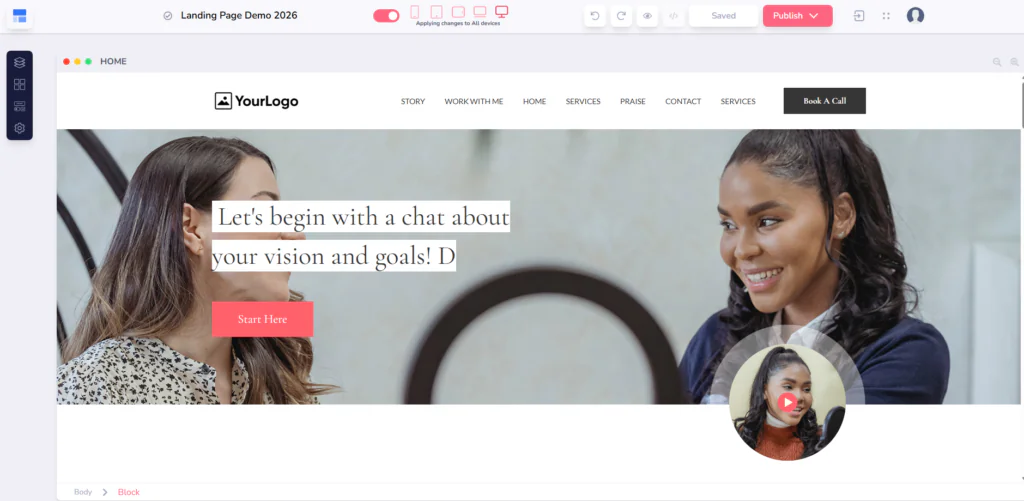
- GroovePages — drag-and-drop website and funnel builder with mobile-responsive templates
- GrooveSell — checkout, order forms, upsells, downsells, and affiliate-ready product funnels
- GrooveMail — email marketing automation, list segmentation, and campaign analytics
- GrooveKart — a full e-commerce storefront, positioned as a Shopify alternative without per-transaction software fees on top of your plan
- GrooveMember — membership site and online course hosting
- GrooveVideo — native video hosting with a proprietary player (higher tiers only)
- GrooveAffiliate — affiliate program management and tracking
- GrooveWebinar — live and automated/evergreen webinar hosting
- GrooveDesk — helpdesk and customer support ticketing
- GrooveCalendar, GrooveSurvey, GrooveQuiz — scheduling, surveys, and quiz funnels
- GroovePipe — a basic CRM for tracking deals through a sales pipeline
- GroovePay — a built-in payment processor with a relatively low transaction fee, though approval can reportedly take several weeks
No other single platform in this price range bundles quite this many categories of software under one login. If you compare the combined cost of separate tools — a funnel builder, an email platform, a checkout system, a webinar tool, and a helpdesk — Groove’s pricing looks genuinely competitive on paper.
Groove.cm: Pros & Cons
- Real cost savings: Cuts monthly software spend significantly if you actually use multiple apps (funnels, email, checkout, webinars) under one bill.
- No credit card required: The free tier is genuinely risk-free, allowing you to test the actual product before spending a dollar.
- Native e-commerce: GrooveKart functions as a complete online store without extra per-transaction software fees (unlike Shopify alternatives).
- One login, one data flow: Smooth data sharing between apps (e.g., moving a contact from an email list straight into a funnel or membership area).
- Steep learning curve: Juggling over a dozen separate apps can feel like products stitched together rather than one cohesive tool.
- Inconsistent support quality: Slow ticket response times, especially for free-plan and lower-tier users, with some tickets going unanswered.
- Aggressive marketing: Heavy reliance on urgency tactics, countdown timers, and delayed feature rollouts for early “lifetime” buyers.
- Varying feature maturity: Core tools like GroovePages are solid, but newer additions (like webinars) can feel underdeveloped.
- Strict contact limits: Unlike some competitors, GrooveMail caps email contact limits even on the highest paid Platinum tiers.
- Limited agency tools: Lacks full white-labeling, unlimited sub-accounts, and SaaS reseller modes needed for managing client accounts.
Who Should Actually Use Groove
Groove tends to make the most sense for:
- Solo entrepreneurs, coaches, and course creators who want funnels, email, and a membership area without juggling five logins
- Affiliate marketers who mainly need landing pages and a checkout flow
- Small e-commerce sellers who want a built-in storefront without paying separate Shopify fees
- Budget-conscious beginners who want to test an online business idea on the free tier before spending anything
It’s a weaker fit for:
- Agencies managing multiple client accounts that need true white-labeling and sub-account management
- Businesses that depend heavily on advanced third-party integrations not yet well-supported inside Groove
- Anyone who has been burned before by “lifetime deal” software and wants a long, well-documented track record before buying in
- Teams that need consistently fast, reliable customer support as a non-negotiable requirement
How Groove Stacks Up Against Alternatives



If you only need one specific piece of what Groove offers, it’s often worth comparing against specialists rather than buying the whole suite:
- For page and funnel building specifically: ClickFunnels, Builderall, or Leadpages
- For email marketing alone: ActiveCampaign or Mailchimp
- For membership sites and courses: Kajabi, Kartra, or Teachable
- For agency-style client management: GoHighLevel, which is purpose-built around unlimited sub-accounts and full white-labeling
Kartra in particular is worth mentioning because it was co-founded by the same person behind Groove and is generally viewed as the more polished, mature all-in-one competitor — though it comes at a higher price point with fewer “free” options.
Final Verdict: Groove Review 2026
Back to the headline question: is Groove really “free forever”? Yes, in the literal sense — the no-credit-card free tier exists, doesn’t expire on its own, and gives you genuine hands-on access to the core apps. But “free forever” was never meant to carry your whole business. It’s an extended test drive, not a long-term home for a company with real traffic, a growing list, or serious sales volume.
For the price, the paid tiers deliver a genuinely broad toolkit, and the math works out favorably if you would otherwise be paying for four or five separate subscriptions. The trade-offs are real, though: a learning curve from juggling more than a dozen mini-apps, inconsistent support response times, a marketing style that has historically leaned on urgency and lifetime-deal hype, and feature maturity that varies a lot from one app to the next.
If you’re a solo creator, coach, or small e-commerce seller who wants to consolidate tools and is comfortable with some rough edges, Groove is worth testing on the free plan before deciding whether to upgrade. If you need polished, mature, dedicated software in any single category — or fast, reliable support as a baseline requirement — you’ll likely be happier paying more for a specialist tool, or for a more established all-in-one competitor like Kartra.
A Note on Doing Your Own Due Diligence
One more thing worth saying plainly: software pricing pages change often, and Groove’s has changed more than most. Plan names, contact limits, and promotional pricing have all shifted multiple times over the platform’s history, which means any specific dollar figure in this review — or in any other review you read — should be treated as a snapshot rather than a permanent fact.
Before you commit to an annual plan or a discounted bundle, take the extra five minutes to open the official pricing page yourself, compare it against what you’ve read, and check the date on any third-party review you’re relying on. Given how frequently this platform has rebranded and repriced, a review that’s even a year old can already be describing a product that no longer exists in that form.
It’s also worth joining the official user community or Facebook group before buying, simply to see what current customers are saying in real time rather than relying solely on marketing copy or older reviews. Communities like this tend to surface support response times, bug reports, and billing issues faster than formal review sites do, and they can give you a much more current read on whether the platform’s rough edges have improved or gotten worse since the last major review cycle.
🔍 Explore More Funnel & Marketing Platform Reviews
If you are still weighing your options and want to compare other top-rated all-in-one platforms in 2026, check out our comprehensive guides and alternative reviews below:
Step-by-Step Guide: Systeme.io Tutorial 2026: Build Your First Sales Funnel in 60 Minutes (No Coding Required)
Market Trends: Why Savvy Creators Are Switching To Systeme.io In 2026?
Head-to-Head Battles: Systeme.io vs ClickFunnels 2026: Honest Comparison — Which One Is Actually Worth It for Solopreneurs?
Course Creator’s Choice: Systeme.io vs Kajabi 2026: Which One Should You Choose to Sell Online Courses on a Budget Under $30/Month?
Frequently Asked Questions
Is Groove (GrooveFunnels) legit, or is it a scam?
Groove is a real, operating software company with hundreds of thousands of registered users. It is not a scam in the sense of taking your money and disappearing. That said, some users who bought early lifetime deals have voiced real frustration over delayed features and inconsistent support, so “legit” doesn’t mean “complaint-free.”
Do I need a credit card to start the free plan?
No. The free tier is explicitly advertised as not requiring a credit card to sign up.
Can I really run a full business on the free plan?
You can start one, but contact limits, page limits, and storage/bandwidth caps mean most growing businesses will need to upgrade fairly quickly.
Is the old lifetime deal still available?
The original beta-era lifetime Platinum deal is generally no longer offered to new members, although Groove has occasionally run limited-time promotional pricing since. Always verify current offers directly on the official site.
What’s the biggest complaint about Groove?
Customer support response time is the most frequently repeated criticism across independent reviews and user communities, particularly for free and lower-tier accounts.