

Table of Contents
If you’ve spent even an hour researching the best online course platforms, you already know the landscape is crowded, confusing, and full of conflicting advice. Some tools bury you in enterprise-grade marketing automation you’ll never touch. Others are cheap funnel builders that treat your course like an afterthought. This guide cuts through the noise with an honest, expert breakdown of the top contenders — and makes the case for why Podia, not the flashier or cheaper alternatives, is the platform most solopreneurs and independent creators should actually choose in 2026.
As someone who has stress-tested course platforms for creator-economy clients across coaching, education, and digital products, I’ve watched solopreneurs waste months and thousands of dollars bouncing between tools that were either overbuilt or under-delivered. This article distills that experience into a clear, no-fluff comparison so you can pick the right platform once — and get back to building your business.
What Makes the Best Online Course Platforms in 2026?
Not all course platforms are built for the same person. A platform designed for a venture-backed edtech startup looks nothing like one designed for a single creator selling a $97 course on the side. Before comparing specific tools, it helps to define the criteria that actually matter for a solopreneur evaluating the best online course platforms.
1. Total Cost of Ownership, Not Just the Sticker Price
Many platforms advertise a low monthly fee, then quietly take a percentage of every sale, charge extra for email marketing, or require a separate payment processor with its own fees. The real cost is the monthly subscription plus every transaction fee, add-on, and third-party tool you’re forced to bolt on.
2. Genuine All-in-One Functionality
Course hosting alone is no longer enough. Creators need to sell coaching calls, digital downloads, memberships, and communities from the same dashboard — without stitching together five separate SaaS subscriptions and hoping the integrations don’t break.
3. A Learning Curve You Can Clear in a Weekend
As a solopreneur, you are the marketing team, the customer support team, and the product team. A platform that requires a certification course just to build your first funnel is a platform that will delay your launch by weeks.
The Top Online Course Platforms for Solopreneurs, Compared
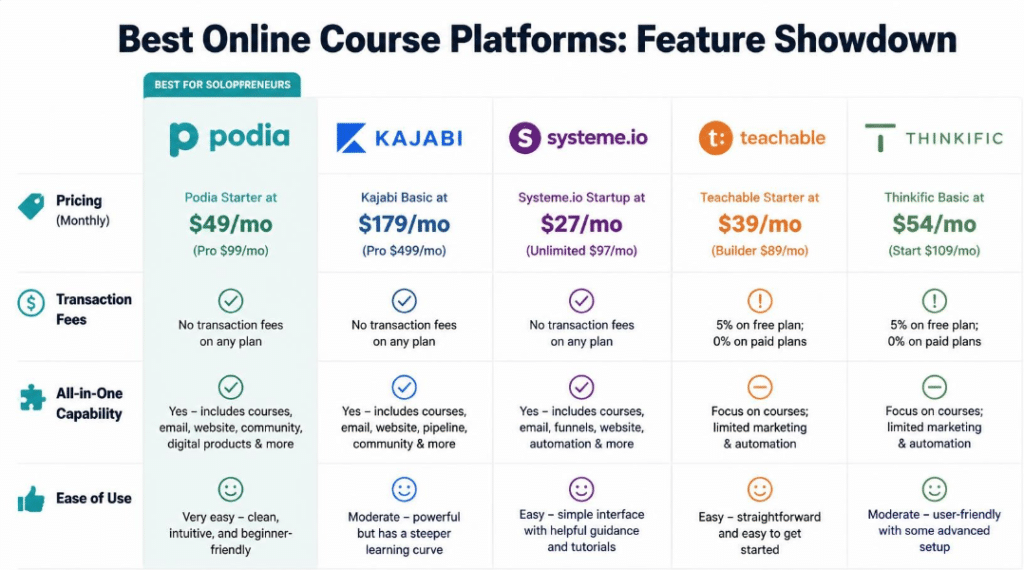
Here is a quick snapshot of how the leading platforms stack up before we dive into the detailed reviews below.
| Platform | Best For | Transaction Fees | Starting Price |
| Podia | Solopreneurs wanting one simple, all-in-one hub | 0% (all plans) | $49/mo |
| Kajabi | Established creators needing enterprise-grade marketing | 0% (but pricier tiers) | $179/mo |
| Systeme.io | Funnel-obsessed marketers on a tight budget | 0% on paid plans | $27/mo |
| Teachable | Course-only sellers who don’t need memberships | 0–5% depending on plan | $39/mo |
| Thinkific | Developers wanting deep customization | 0% (app add-ons cost extra) | $54/mo |
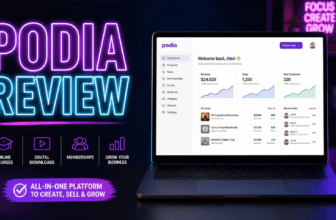
Podia Review: The All-in-One Sweet Spot Every Solopreneur Has Been Looking For
Of every platform on this list, Podia is the one that consistently earns the recommendation for solopreneurs who want to launch fast, keep 100% of their margin, and never touch a support ticket about a confusing setting. It occupies a rare position in this market: powerful enough to run a full digital-product business, yet simple enough that a complete beginner can publish a course before lunch.
All-in-One Simplicity: Courses, Memberships, and Digital Downloads Under One Roof
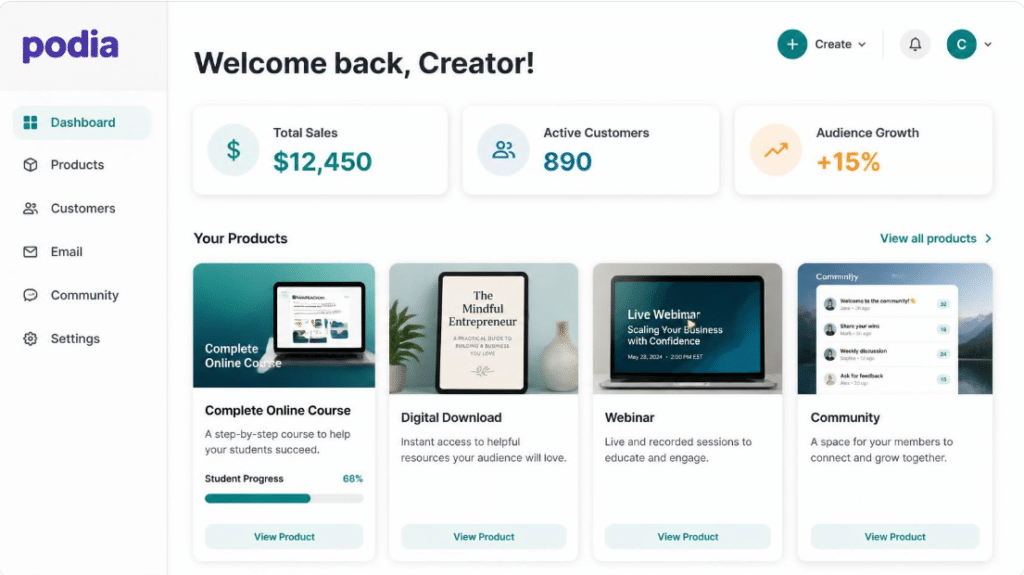
Podia lets you sell online courses, coaching sessions, digital downloads, and recurring memberships from a single dashboard — with one login, one checkout, and one customer list. There’s no need to connect a separate membership plugin or a third-party file-delivery tool. For a solopreneur, this consolidation isn’t a nice-to-have; it’s the difference between spending your evenings improving your product and spending them debugging integrations.
Zero Transaction Fees, on Every Plan
This is where Podia genuinely separates itself from much of the market. While several competitors quietly take a cut of every sale on their entry-level tiers, Podia charges 0% transaction fees across all of its plans, including the most affordable one. Every dollar a customer pays for your course stays in your pocket, which matters enormously when you’re still building toward consistent monthly revenue.
Built for Beginners, Without Feeling Limiting
Podia’s editor is refreshingly straightforward: drag-and-drop page building, pre-built storefront templates, and a checkout flow that just works out of the box. You don’t need to hire a developer or watch a six-hour onboarding series to get a professional-looking course site live. At the same time, Podia doesn’t sacrifice depth — email marketing, affiliate programs, and coupon codes are all built in, so you won’t outgrow it the moment your audience starts to scale.
Why Podia Hits the ‘Sweet Spot’ Between Kajabi and Systeme.io
This is the central insight for anyone comparing the best online course platforms: the market has a clear complexity spectrum. On one end sits Kajabi — a genuinely powerful platform, but one built with pricing and feature depth aimed at established creators running six-figure funnels, not solopreneurs just getting started. On the other end sits Systeme.io — inexpensive and broad, but its jack-of-all-trades approach to funnels, courses, and automations often leaves the actual course experience feeling like an afterthought, with a rougher, less polished interface.
Podia sits precisely in between. It has the design polish, all-in-one product range, and marketing tools of a premium platform, at a price and simplicity level that respects a solopreneur’s budget and time. You are not paying for automation complexity you won’t use, and you are not settling for a bare-bones tool that makes your business look unfinished.
Related article:
Podia vs Teachable for Beginners: Which Course Platform Should You Choose?
Podia Review 2026: Is It Still the Best All-in-One Platform for Creators?
Other Top Online Course Platforms Worth Knowing
Podia is the strongest overall pick for most solopreneurs, but it’s worth understanding where the other major players fit — and why they fall short of that same balance.
Kajabi: Powerful, but Built for a Different Stage of Business
Kajabi remains one of the most feature-rich platforms available, with advanced marketing automation, robust analytics, and a polished mobile app. The trade-off is cost and complexity: plans start well above what most solopreneurs need to pay in their first year, and the sheer number of features can feel overwhelming when all you want to do is sell your first course.
Systeme.io: Budget-Friendly, but Course Delivery Feels Secondary
Systeme.io is genuinely one of the cheapest all-in-one tools on the market, and its funnel builder is capable. But because its core identity is a sales-funnel and automation tool, the course-hosting experience — the part your actual customers interact with — often feels like a secondary feature bolted onto a marketing suite, with a less refined student experience than purpose-built platforms.
Teachable: A Solid Course-First Alternative
Teachable is a dependable option if courses are truly the only product you’ll ever sell. It offers clean course-building tools and reliable video hosting, but it lacks the native membership and digital-download flexibility that solopreneurs increasingly need as they diversify their offers beyond a single course.
Thinkific: Flexible, but Requires More Assembly
Thinkific offers strong customization and a generous free plan, making it attractive for technically inclined creators. However, many of its more advanced marketing and community features live behind paid app integrations, which means the ‘all-in-one’ promise often comes with extra costs and extra tools to manage.
Podia vs. Kajabi vs. Systeme.io: Finding Your True Sweet Spot
To make the positioning concrete, here’s a side-by-side look at how these three platforms handle the criteria that matter most to a solopreneur evaluating the best online course platforms for their next launch.
| Criteria | Kajabi (Too Much) | Podia (Just Right) | Systeme.io (Too Broad) |
| Learning Curve | Steep; weeks to master automations | Gentle; launch in a day | Moderate; funnel logic can confuse beginners |
| Core Focus | Marketing suite with courses attached | Courses, memberships & digital products, unified | Sales funnels with courses as an afterthought |
| Pricing Fit for Solopreneurs | Expensive relative to early-stage revenue | Proportionate to a lean, one-person budget | Cheap, but design and support feel unfinished |
| Design Polish | High, but overkill for simple offers | Clean, professional, no design skill needed | Functional but visually rough |
| Support Quality | Good, but slower on lower tiers | Fast, consistently praised live chat | Inconsistent, community-driven |
Who Should Choose Podia?
Podia is the right call if you recognize yourself in any of the following:
- You’re a solopreneur or small creator launching your first course, membership, or digital product and don’t want to manage five different tools.
- You want to keep 100% of your sales revenue without losing a percentage to transaction fees on every checkout.
- You value a clean, professional storefront but don’t have the time (or desire) to master a complex marketing automation suite.
- You plan to expand beyond a single course into coaching, memberships, or downloadable products, and want one platform that grows with you.
- You want responsive customer support without needing to be on the most expensive plan to get it.
Join the all-in-one platform built for creators who’d rather build than tinker.
Final Verdict: The Best Online Course Platform for Solopreneurs in 2026
When you weigh cost, ease of use, and true all-in-one functionality, Podia stands out as the best online course platform for solopreneurs and independent creators who need to move fast without sacrificing professionalism. It isn’t trying to be everything to everyone the way Kajabi and Systeme.io do at opposite ends of the spectrum — it’s built precisely for the person doing the marketing, the teaching, and the customer support all by themselves.
If you’re ready to stop researching and start building, the smartest next step is to try the platform that removes the most friction between your idea and your first paying student.
No transaction fees. No complicated setup. Just your course, live and selling.
Frequently Asked Questions About the Best Online Course Platforms
Is Podia really free of transaction fees?
Yes. Podia charges 0% transaction fees on all of its paid plans, meaning you keep the full amount your customers pay, minus standard third-party payment processing fees (such as Stripe or PayPal’s own charges).
Is Podia better than Kajabi for beginners?
For most beginners, yes. Kajabi offers more advanced marketing automation, but that depth comes with a steeper learning curve and a significantly higher starting price — overhead that most solopreneurs don’t need in their first year.
Can I sell memberships and coaching, not just courses, on Podia?
Yes. Podia supports online courses, digital downloads, coaching sessions, and recurring memberships natively, all managed from the same dashboard and customer list.
Which platform is cheapest overall?
Systeme.io typically has the lowest entry price, but the savings often come at the cost of a less polished course experience. When you factor in design quality, support, and ease of use, Podia offers the strongest value for the price among the best online course platforms available today.