
TrueProfit vs BeProfit 2026: Which App Calculates Shopify Profit More Accurately?
 NexLaunchLab Team
If you run a Shopify store, you already know that revenue is not profit. Ad spend, COGS, shipping, payment fees, refunds, and taxes can quietly eat away your margins — and most store owners only find out at the end of the month, when it’s too late to fix anything.
That’s where profit-tracking apps like TrueProfit and BeProfit come in. Both promise to show your real net profit in real time, but they take very different approaches to data accuracy, integrations, and pricing.
In this guide, we’ll break down both tools side by side so you can decide which one actually deserves a spot in your tech stack in 2026.
What’s Inside This Guide
What Is TrueProfit?
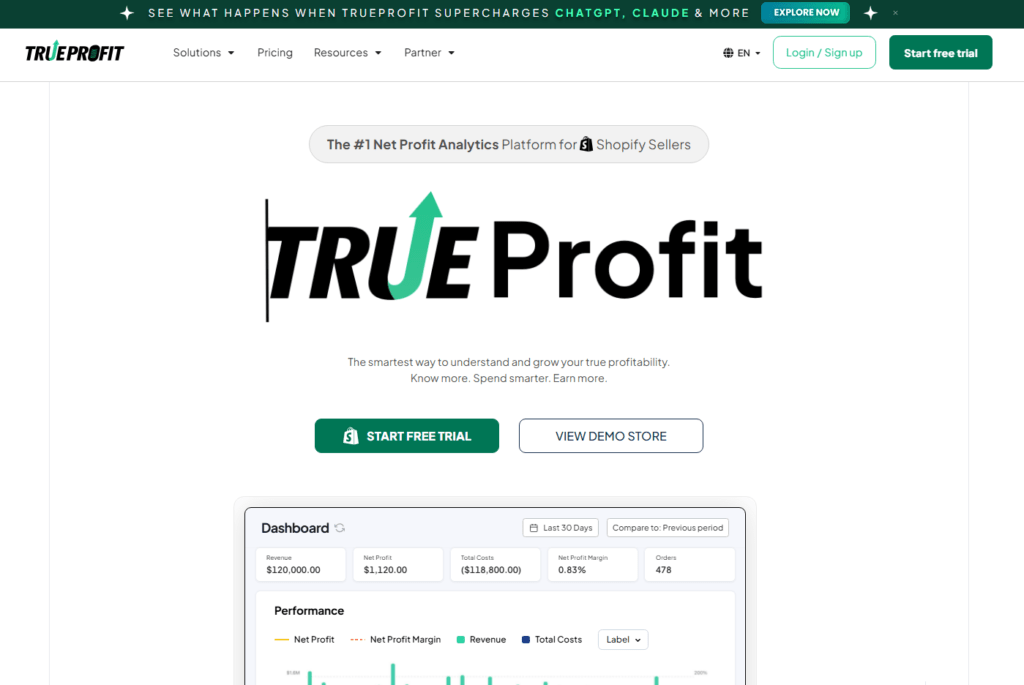
TrueProfit is a profit analytics app built specifically for Shopify and Shopify Plus stores. It pulls data directly from Shopify, ad platforms (Facebook, Google, TikTok, Pinterest), and payment gateways to calculate net profit after costs — automatically, without manual spreadsheet work.
Its core selling point is accuracy down to the order level: TrueProfit recalculates COGS, fees, and ad spend per SKU and per order, rather than estimating averages.
Key Features of TrueProfit
- Real-time profit dashboard (revenue, COGS, fees, ad spend, net profit, profit margin)
- Order-level and SKU-level cost tracking
- Multi-channel ad spend sync (Meta, Google, TikTok, Pinterest, Snapchat)
- Customer lifetime value (LTV) and cohort analysis
- Custom cost rules (shipping, handling, taxes, payment gateway fees)
- Daily email/Slack profit reports
- Multi-store and multi-currency support
What Is BeProfit?
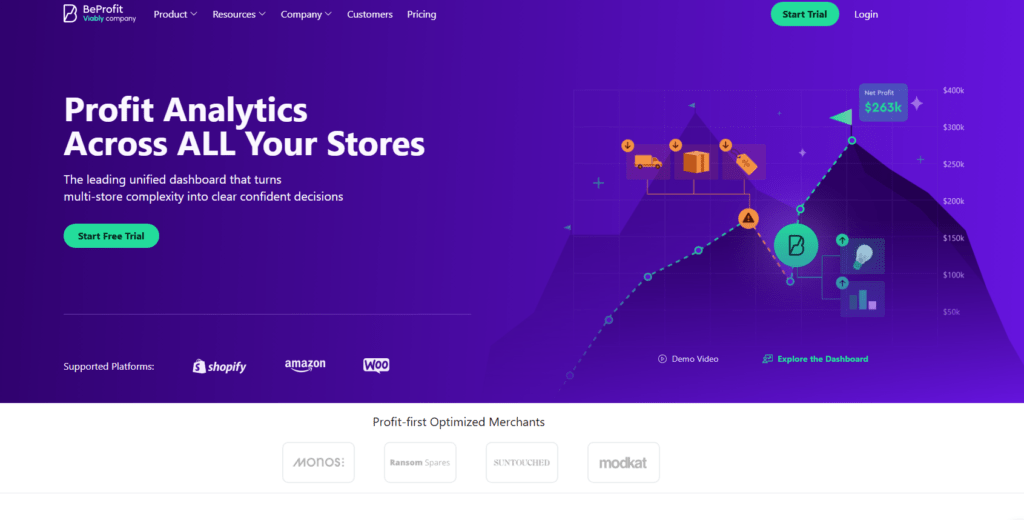
BeProfit is another popular Shopify profit-tracking app, well known among dropshippers and growing brands. It focuses on giving a clear, simple profit-and-loss (P&L) view, plus product- and ad-level breakdowns.
Key Features of BeProfit
- Profit & loss dashboard with daily/weekly/monthly views
- Product profitability breakdown
- Ad spend tracking integration with major ad platforms
- Customer analytics (repeat customers, LTV)
- Custom expense tracking (manual entries supported)
- Multiple report templates
- App marketplace with add-ons for extra features
TrueProfit vs BeProfit: Head-to-Head Comparison
1. Profit Calculation Accuracy
This is the single most important factor for most store owners — and where the two apps diverge most.
TrueProfit calculates costs at the order and line-item level, syncing COGS changes historically so past orders reflect the cost that was actually true at the time of sale. This avoids one of the most common profit-tracking mistakes: retroactively distorting historical profit when you update a product’s cost today.
BeProfit also tracks COGS and fees, but several users report that its cost allocation can be less granular when dealing with bundles, variants, or frequently changing supplier costs, which can introduce small discrepancies over time.
Verdict: TrueProfit has a slight edge for stores with complex SKU structures, variant-heavy catalogs, or frequent cost changes.
2. Ad Spend & Marketing Integration
Both apps connect to Meta Ads, Google Ads, and TikTok Ads to pull spend data automatically. The difference shows up in attribution depth:
- TrueProfit ties ad spend to actual orders and calculates blended ROAS and break-even ROAS automatically.
- BeProfit shows ad spend alongside revenue but offers fewer built-in attribution metrics out of the box.
If you’re running paid acquisition aggressively, this distinction matters a lot — you want to know which campaigns are profitable, not just which ones drive revenue.
3. Dashboard & Reporting
BeProfit’s interface is often praised for being clean and beginner-friendly, with ready-made report templates that are easy to read at a glance.
TrueProfit’s dashboard is more data-dense, aimed at store owners who want a deeper breakdown (cohort retention, LTV trends, per-channel profitability) without exporting data elsewhere.
Verdict: BeProfit wins on simplicity for beginners; TrueProfit wins on analytical depth for data-driven operators.
4. Pricing
Pricing on both apps is based on monthly order volume, and both offer free trials. As of 2026:
- TrueProfit offers tiered plans starting from a free/low-cost entry plan, scaling up based on order volume, with all core profit-tracking features available even on lower tiers.
- BeProfit similarly scales by order volume, but several advanced features (like deeper ad attribution or extra integrations) are gated behind higher-tier plans or paid add-ons.
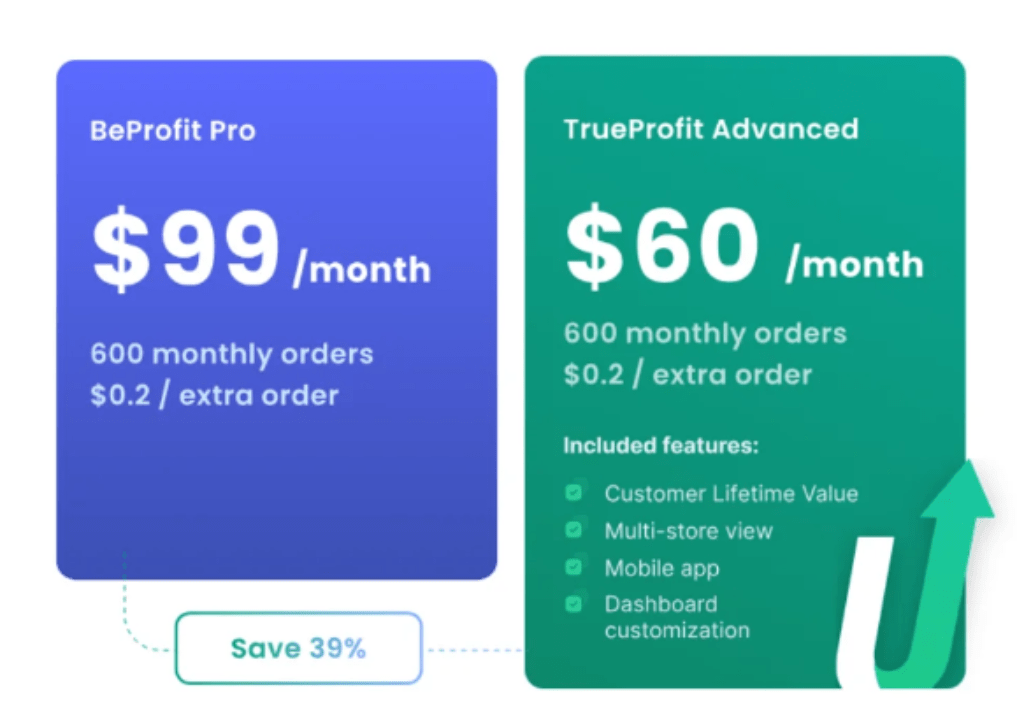
Verdict: TrueProfit tends to offer more core functionality at lower tiers; BeProfit’s add-on marketplace can increase total cost if you need extra features.
5. Customer Support & Onboarding
Store owners frequently mention that TrueProfit’s support team is responsive and hands-on during onboarding, helping set up cost rules correctly from day one — which matters a lot since profit accuracy depends entirely on correct setup.
BeProfit also offers support, including live chat, but some users note slower response times during peak periods.
6. Integrations Ecosystem
| Feature | TrueProfit | BeProfit |
| Shopify & Shopify Plus | ✅ | ✅ |
| Meta / Google / TikTok Ads | ✅ | ✅ |
| Multi-currency | ✅ | ✅ |
| Multi-store dashboard | ✅ | Limited on lower plans |
| Historical COGS accuracy | ✅ | Partial |
| Cohort & LTV analysis | ✅ | Basic |
| Custom cost rules | ✅ | ✅ |
Who Should Choose TrueProfit?
TrueProfit is the better fit if:
- You run a store with many SKUs/variants and frequently changing supplier costs
- You spend heavily on paid ads and need accurate ROAS/break-even data
- You want deep cohort and LTV analytics without extra tools
- You manage multiple Shopify stores
Who Should Choose BeProfit?
BeProfit is the better fit if:
- You’re a smaller store or just starting out and want something simple
- You prioritize a clean, easy-to-read P&L view over deep analytics
- You don’t need advanced ad attribution modeling
Final Verdict: TrueProfit vs BeProfit
Both apps solve the same core problem — giving Shopify merchants a real picture of profit instead of just revenue. But for stores that have scaled past the basics, especially those running multi-channel ads or managing complex product catalogs, TrueProfit generally delivers more accurate, order-level profit data and deeper insights at a comparable or lower price point.
BeProfit remains a solid, beginner-friendly option if your main need is a simple, clean profit dashboard without much complexity.
Try It Yourself
The best way to know which tool fits your store is to test it with your own data — both apps offer free trials.
FAQs
Is TrueProfit free? TrueProfit offers a free trial and entry-level plans suitable for small stores; pricing scales with order volume.
Does BeProfit work with Shopify Plus? Yes, BeProfit supports Shopify and Shopify Plus stores.
Which app is more accurate for COGS tracking? TrueProfit’s order-level, historically accurate COGS tracking generally provides more precise profit numbers, especially for stores with variant-heavy catalogs.
Can I use both apps at once? Technically yes, but most merchants pick one to avoid duplicate tracking and conflicting profit numbers.
Recent Posts:
TrueProfit Review 2026: Is This Shopify Profit-Tracking App Worth $35/Month?
How to Create a Free Landing Page With Groove in 30 Minutes — No Credit Card Required