

An independent, feature-by-feature evaluation for creators and media brands deciding on their newsletter infrastructure.
What’s Inside This Guide
The Infrastructure Decision Every Newsletter Founder Has to Make
Email marketing in 2026 looks nothing like it did five years ago. Inboxes are more crowded, algorithmic gatekeeping on social platforms keeps getting stricter, and audience ownership has become the closest thing creators have to a moat. Against that backdrop, the platform a newsletter is built on is no longer a cosmetic choice — it determines how fast a list grows, how (and whether) it can be monetized, and how much operational overhead the founder carries as the audience scales.
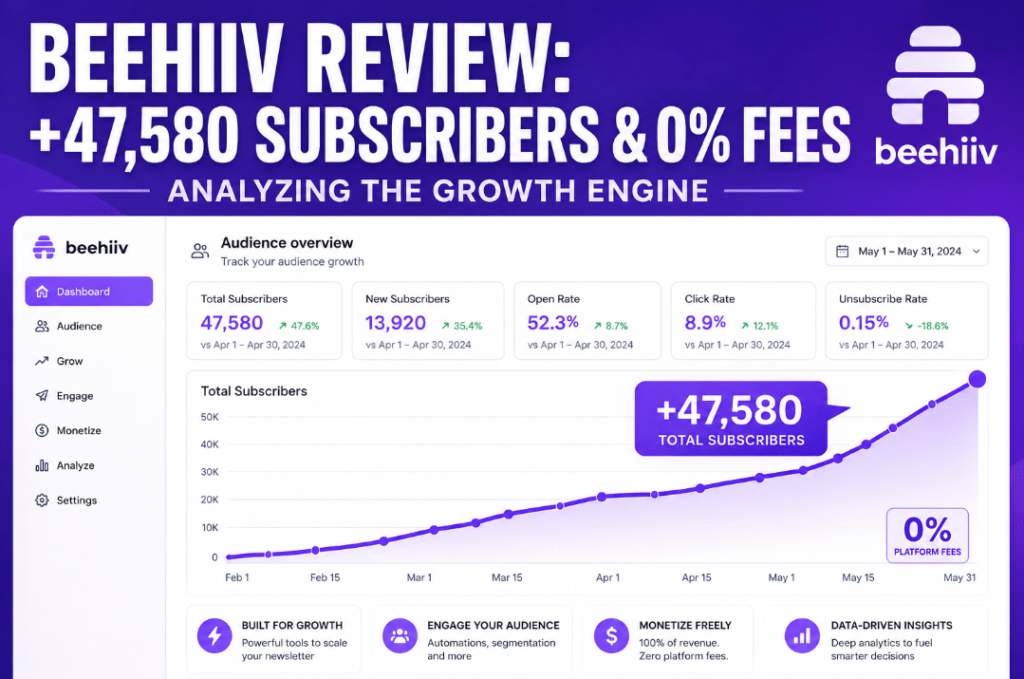
That’s the context for this Beehiiv review: a close look at a platform that has positioned itself less as an email service provider (ESP) and more as an end-to-end operating system for media businesses. Beehiiv was built by a team with direct experience scaling Morning Brew, and its product decisions reflect that background — growth and monetization are treated as first-class features, not add-ons bolted onto a traditional email tool. The question this article answers is not “is Beehiiv good,” but “good for whom, and at what trade-off.”
What Beehiiv Actually Is
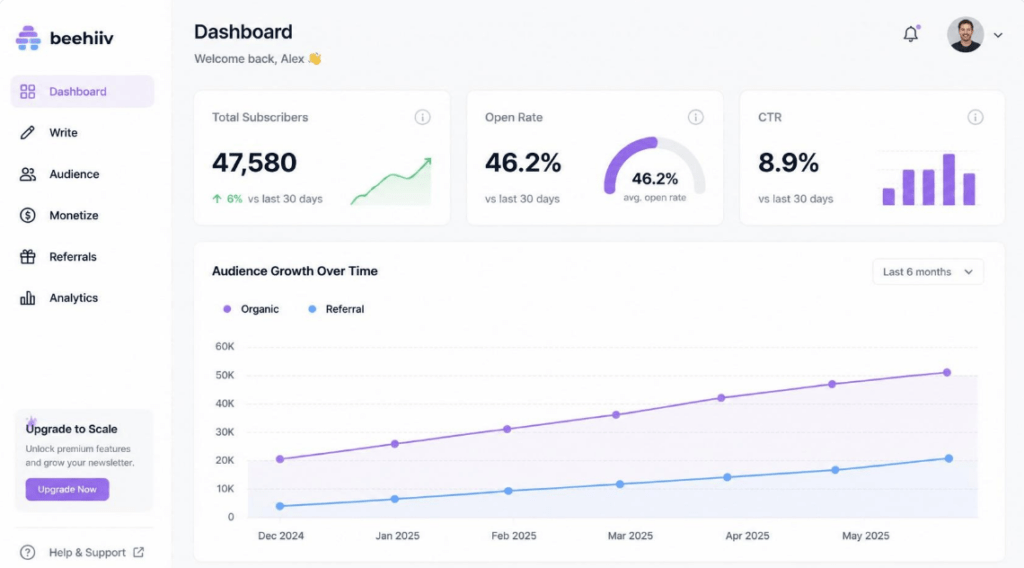
Beehiiv bundles four functions that most creators previously had to stitch together from separate tools: an email sending engine, a website/landing-page builder, a subscriber-monetization layer (paid subscriptions, ads, sponsorships), and a growth layer (referrals and cross-newsletter recommendations). Substack popularized the all-in-one publishing model; Beehiiv’s differentiation is leaning much harder into growth mechanics and revenue infrastructure, aiming squarely at creators who want to treat their newsletter as a business rather than a hobby or a blog with an email button.
Beehiiv Review: Core Features That Actually Move the Growth Needle
Most platform comparisons list features without weighing their real operational impact. Here’s what matters in practice, based on how these tools behave once a list moves past the early, easy-growth stage.
1. The Referral Program & Boosts Marketplace
Beehiiv ships with a native referral program: subscribers earn tiered rewards (exclusive content, swag, paid-tier access) for referring new readers, tracked automatically without third-party tools like SparkLoop bolted on. Layered on top is Boosts, a built-in marketplace where newsletters pay each other for verified subscriber referrals. A publisher can either pay to be recommended to other newsletters’ audiences, or earn revenue by recommending other newsletters to their own list — publishers set their own per-subscriber rate, and Beehiiv only charges once the referred subscriber is verified.
The strategic impact is real: this converts list growth from a pure ad-spend problem into a marketplace with transparent, per-subscriber pricing. For a newsletter with an engaged, well-defined audience, Boosts can become a genuine secondary revenue stream rather than just an acquisition cost. The caveat is that it works best in categories with active buyer demand (business, tech, finance, personal finance); niche or low-density categories see thinner marketplace liquidity.
2. The Recommendation Network
Distinct from Boosts, the recommendation network lets publishers add other newsletters to a post-signup “you might also like” screen, at no direct cost. It’s a lower-friction, community-style growth channel — less predictable than Boosts, but free, and genuinely useful for smaller newsletters that don’t yet have budget to spend on paid referrals.
3. Monetization Tools: Paid Subscriptions, Ad Network, and Sponsorships
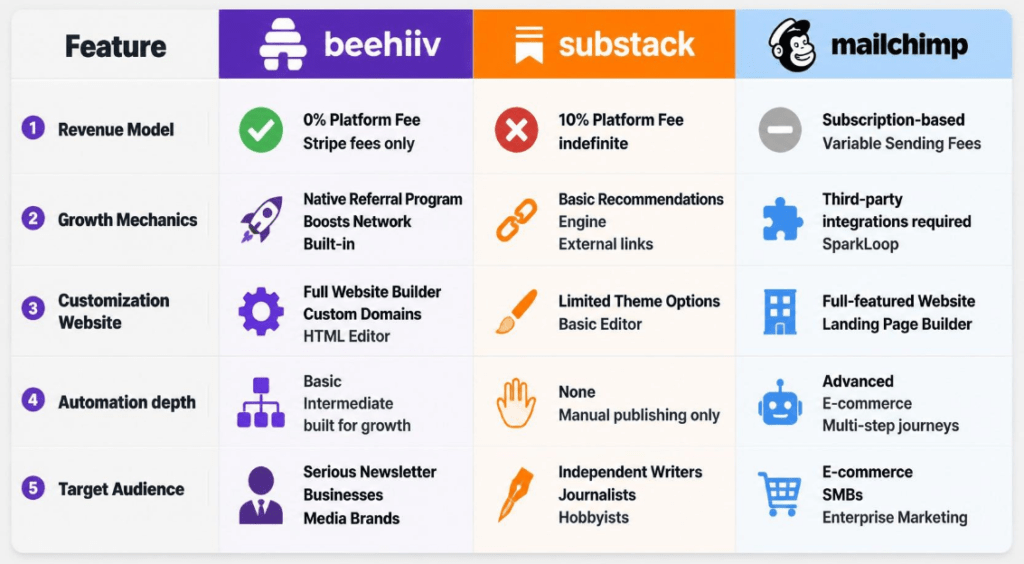
This is where Beehiiv’s positioning diverges most sharply from Substack. Beehiiv takes 0% commission on paid subscription revenue — creators only pay standard Stripe processing fees (roughly 2.9% + $0.30 per transaction). Substack, by contrast, takes a flat 10% cut of all subscription revenue indefinitely. On a newsletter generating meaningful recurring revenue, that difference compounds into thousands of dollars a year.
- Paid subscriptions: gated content, member tiers, 0% platform fee.
- Beehiiv Ad Network: the platform matches sponsors to newsletters by audience and category; Beehiiv takes a cut (commonly cited around 15%) of brokered ad revenue.
- Direct sponsorships: available on higher tiers, giving publishers more control over selling and structuring their own sponsorship packages.
Realistically, the Ad Network is not a monetization option for brand-new lists — it requires a minimum subscriber threshold and consistent sending activity before advertisers are willing to book. It’s a strong lever for newsletters that have already found traction, not a bootstrapping tool.
4. Advanced Analytics
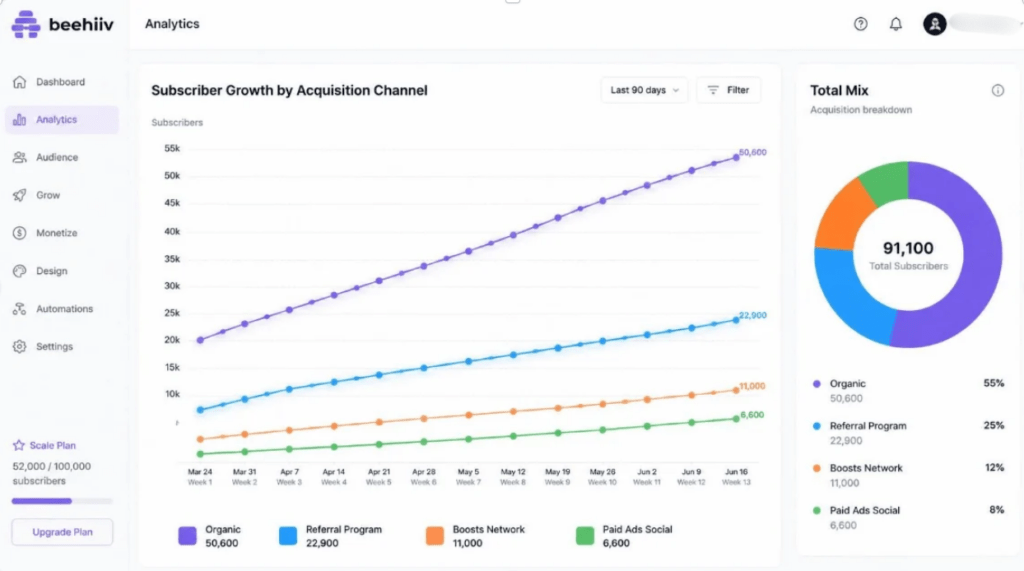
Beehiiv’s analytics go beyond opens and clicks to include revenue attribution per post, subscriber growth broken down by acquisition channel (organic, referral, Boosts, paid ads), and a “Verified Clicks” feature designed to filter out bot and pre-fetch traffic that has increasingly inflated open/click metrics across the email industry since Apple Mail Privacy Protection. For a publisher trying to prove ROI to sponsors or make data-driven editorial decisions, this level of granularity is a meaningful upgrade over the basic reporting most legacy ESPs still offer.
The Good and The Bad: An Honest Trade-Off Analysis
No platform is a universal best choice. Here’s where Beehiiv earns its reputation, and where it genuinely falls short — including against Substack and Mailchimp, the two tools it’s most often compared to.
Where Beehiiv Excels
- Monetization economics: 0% fee on paid subscriptions is a structural advantage over Substack’s 10% cut, and it compounds as subscription revenue grows.
- Built-in growth loops: the referral program and Boosts marketplace are natively integrated, rather than requiring a third-party tool and a separate contract.
- A genuinely usable free tier: the Launch plan supports up to 2,500 subscribers with unlimited sends and no artificial send caps — more generous than most competitors’ free tiers, including Mailchimp’s.
- Website and landing pages included: publishers don’t need a separate CMS or landing-page tool to launch and grow a subscriber base.
- Ownership and portability: unlike Substack, which nudges publishers toward its own discovery ecosystem, Beehiiv leans more toward giving creators an independent, brandable presence.
Where It Falls Short
- Automation depth: compared to marketing-automation-first platforms like Kit (formerly ConvertKit) or ActiveCampaign, Beehiiv’s workflow and segmentation tools are comparatively basic — it’s built for newsletter growth, not complex multi-step lifecycle marketing.
- Pricing cliff above the free tier: there is no low-cost middle tier. The moment a publisher needs monetization, automations, or advanced segmentation, the jump from $0 to a Scale-plan subscription is immediate rather than gradual.
- Subscriber-based pricing at scale: because Scale and Max pricing increases in steps as the subscriber count grows (regardless of engagement), a large but under-monetized list can become an expensive line item — list hygiene directly affects the bill.
- Learning curve for the Ad Network: matching with advertisers, refining targeting preferences, and building a track record takes real time and isn’t a fast monetization path for a brand-new list.
- Support responsiveness: several long-term users report that support is largely asynchronous, which can slow down troubleshooting during time-sensitive sends.
Pricing Breakdown (2026)
Beehiiv prices by subscriber count rather than send volume, across four tiers. Entry prices apply at the lowest subscriber bracket and increase at fixed thresholds (2,500 / 5,000 / 10,000 / 25,000 / 50,000 / 75,000 / 100,000+) as a list grows. Annual billing typically saves roughly 12–16% versus monthly.
| Plan | Starting Price* | Subscriber Cap | Best For |
| Launch | Free | Up to 2,500 | Testing the platform, early-stage lists |
| Scale | ~$43–49/mo | Scales with list size | Monetization-ready creators (referrals, ad network, paid subs) |
| Max | ~$96–109/mo | Scales with list size | Publishers needing white-labeling, podcast hosting, priority support |
| Enterprise | Custom | 100,000+ | Large media brands and publishers |
*Prices reflect published 2026 rates and vary by billing cycle (monthly vs. annual) and current subscriber count; verify current figures directly on Beehiiv’s pricing page before committing.
Who Beehiiv Is Actually For
Beehiiv makes the most sense for creators and small media teams who are past the pure hobby stage and are actively building toward monetization — through paid subscriptions, sponsorships, or an ad network — and who want growth mechanics (referrals, recommendations, Boosts) built into the platform rather than assembled from three separate vendors. It’s a weaker fit for two groups: those who want the simplest possible writing-and-publishing experience with no growth machinery (Substack remains lighter and more editorially focused), and those who need deep marketing automation and CRM-grade segmentation for e-commerce or lead-nurturing use cases, where a tool like Kit or ActiveCampaign will outperform it.
Final Verdict
This Beehiiv review concludes what most rigorous comparisons find: Beehiiv is not the cheapest newsletter tool, nor the simplest, but it is one of the few platforms where growth and monetization infrastructure is genuinely native rather than stitched on. For a solopreneur or small team serious about turning a newsletter into a revenue-generating media asset, the combination of a 0% subscription fee, a built-in referral economy, and an increasingly sophisticated analytics layer is difficult to replicate by combining cheaper point solutions — the switching and integration costs alone often outweigh the savings.
That said, the decision should be made on fit, not hype. A writer who just wants to publish essays without thinking about growth loops may find Substack’s simplicity more appealing. A team running complex, multi-channel automated campaigns will likely outgrow Beehiiv’s workflow tools. For everyone building a newsletter as a business — one that needs to acquire subscribers efficiently, monetize them directly, and measure the results with precision — Beehiiv remains one of the strongest infrastructure choices available in 2026.
Recent Post:
From Blog to Inbox: How to Connect Jasper AI and Brevo for an Automated Content Funnel
How to Train Jasper AI’s Brand Voice in 10 Minutes (So Your Content Doesn’t Sound Like a Robot)