
If you’re searching “beehiiv vs kit” right now, chances are you’re past the “what is email marketing” phase. You’re standing at a genuine fork in the road: picking the wrong platform at this stage can cost you 6-12 months re-exporting your subscriber list, rebuilding every automation from scratch, and — worse — losing the growth momentum your revenue just started to build.
This article isn’t here to crown one universal winner. Having personally run campaigns on both platforms across different business models — solo newsletters, digital creators selling courses, and media startups raising funding — I’ll walk you through an honest Beehiiv review measured directly against Kit (the new name for ConvertKit), so you can see which platform actually fits your business model instead of chasing whichever one is trending on X.
What’s Inside This Guide
Who Are Beehiiv and Kit (ConvertKit), Really?
Before comparing features, it helps to understand the DNA behind each platform — because that DNA shapes every product decision that follows.
Beehiiv — Built by Media People, Engineered to Scale
Beehiiv was founded by former Morning Brew team members — one of the most successful newsletters in the world. So it’s no surprise the entire product is built with a “publisher” mindset: fast list growth, monetization through ads and referrals, and deep analytics that let you optimize every send the way a real newsroom would.
Kit (ConvertKit) — A Commerce Platform for Creators
ConvertKit rebranded to Kit in 2024, marking a clear shift: from a pure email marketing tool to a “Creator Commerce” ecosystem — where automation, tagging, and selling digital products (courses, ebooks, coaching) sit at the center of the experience. If you’ve been searching for the best newsletter software for selling directly to your list, Kit almost always shows up near the top.
Detailed Comparison: Beehiiv vs Kit Head-to-Head
1. Interface & User Experience (UI/UX)
This is what determines how fast you go from signing up to sending your first email — and for beginners, it directly affects whether they stick around or give up halfway.
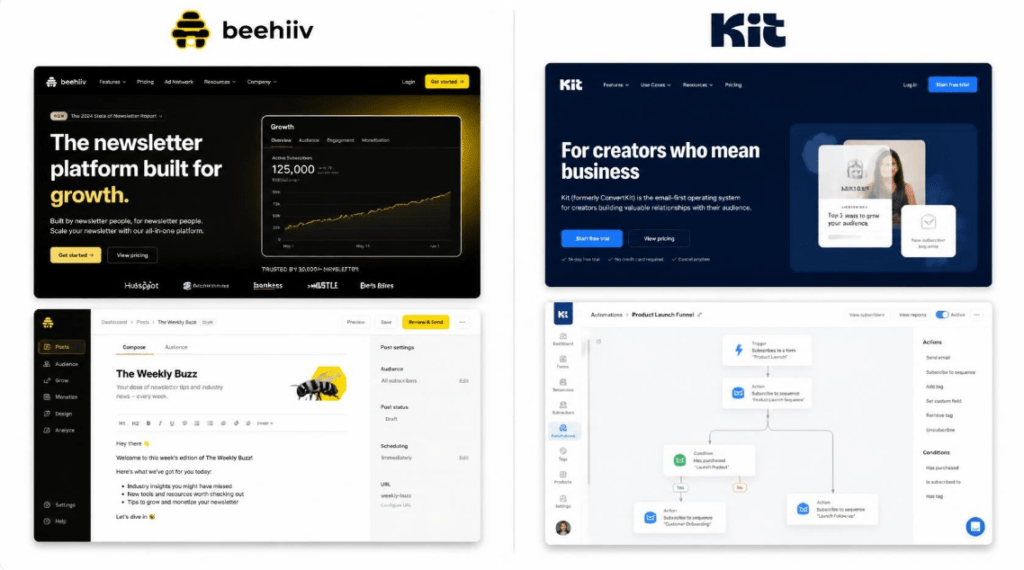
- Beehiiv: A block-based email editor, clean and fast-loading. The dashboard centers on growth metrics (open rate, growth rate, referrals) — it feels like running a mini newsroom. The learning curve is fairly gentle for newcomers.
- Kit: A visual, drag-and-drop flowchart builder for automations, widely considered one of the most intuitive on the market. The email editor itself, however, is simpler and more text-first than Beehiiv’s — better suited to a personal-letter writing style than a magazine-style newsletter.
Quick takeaway: If polished, magazine-style newsletters matter most to you, Beehiiv has the edge. If you care more about visually building complex automation flows, Kit wins this round.
2. Segmentation, Tagging, and Automation
This is the backbone that determines how well you can personalize the subscriber experience — critical once your list grows past a few thousand people.
- Kit: Nearly unmatched here. A flexible tagging system lets you tag based on behavior (opens, link clicks, purchases, specific page views), combined with a visual automation builder for building multi-branch (if/else) sales funnels with no code required.
- Beehiiv: Offers engagement-based segmentation (engaged/unengaged) and a handful of basic conditions, but the depth of its automation logic still trails Kit. Beehiiv is improving quickly here, but as of now it still leans more toward mass broadcasts than nurturing individual branches.
RELATED ARTICLES:
Beehiiv Review: An Analytical Breakdown of the Newsletter Platform Built for Growth (2026)
3. Monetization Features
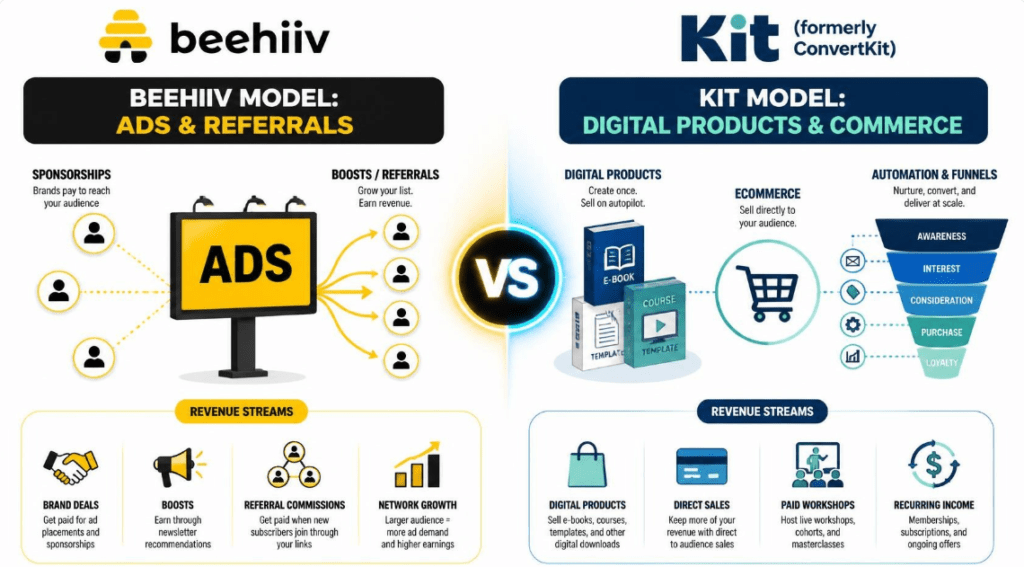
This is where the two product philosophies diverge most sharply — and the core question you need to answer is: do you make money from ads/referrals, or from selling digital products?
- Beehiiv: Comes with a built-in Ad Network that connects eligible newsletters directly with brands looking to buy inline ad placements — a near-exclusive feature. It also includes Boosts (a referral network similar to SparkLoop) to cross-grow your list with other newsletters.
- Kit: Ships with Kit Commerce, letting you sell digital products, courses, and paid subscriptions directly on-platform without a third-party tool, plus a Creator Network for cross-promotion among creators.
In short: If your revenue comes from sponsors/advertisers in a media-style model, Beehiiv was built exactly for that. If your revenue comes from selling digital products directly to subscribers, Kit is the more natural fit.
4. Pricing and Scalability
Over the long run, pricing structure determines your profit margin as your email list grows exponentially.
- Beehiiv: A generous free plan supporting up to 2,500 subscribers with most core features unlocked. Paid tiers scale with subscriber count like most competitors, but sending volume is unlimited — a real advantage for high-frequency newsletters.
- Kit: Also has a free plan (up to roughly 10,000 subscribers for basic features, without advanced automation). Paid tiers scale with subscriber count and progressively unlock automation and Kit Commerce features.
Important CRO note: Don’t just look at the first month’s sticker price. Run the numbers at the 10,000 and 50,000 subscriber mark — that’s where the two platforms really start to diverge in cost-efficiency per email sent.
Quick Comparison Table: Beehiiv vs Kit
| Criteria | Beehiiv | Kit (ConvertKit) |
| Core strength | List growth & monetization via ads/referrals | Automation & direct digital product sales |
| Email editor UX | Polished, block-based, magazine-style | Simple, text-first, personal-letter feel |
| Automation/Tagging | Basic to moderate, improving fast | Very strong, intuitive visual builder |
| Monetization | Ad Network, Boosts (referrals) | Kit Commerce (courses, digital products, subscriptions) |
| Free plan | Generous, up to 2,500 subscribers | Available, but limited advanced automation |
| Best suited for | Media founders, large independent newsletters | Creators selling courses, coaching, digital products |
So Which One Should You Actually Use? Recommendations by Persona
This is the most important section — because “the best platform” doesn’t exist independently of your business model.
Persona 1: Independent Creator Selling Courses, Coaching, or Ebooks
Recommendation: Kit. If your main revenue comes from selling digital products directly to your list, Kit’s purchase-behavior automation and detailed tagging will help you build a far more effective sales funnel than bolting on a third-party tool.
Persona 2: Someone Building a Large-Scale Media Company or Newsletter
Recommendation: Beehiiv. If your goal is rapid list growth and monetizing through sponsorships/ads the way Morning Brew or The Hustle did, Beehiiv’s Ad Network and Boosts were built exactly for this purpose.
Persona 3: B2B Marketer Needing Complex Automation and Deep CRM Integration
Recommendation: Weigh carefully. Kit still edges out Beehiiv on internal automation flexibility, but if you need enterprise-grade CRM/sales pipeline integration, neither platform is the deepest option on the market — you may want to evaluate dedicated enterprise automation tools alongside either one.
Persona 4: Beginners on a Tight Budget, Still Figuring Out Their Monetization Model
Recommendation: Beehiiv. A generous free plan and a friendly interface let you experiment with content and build an initial list at no cost, before committing long-term to a paid platform.
Final Verdict: Beehiiv vs Kit — There’s No Absolute Winner, Only the Right Fit
After weighing beehiiv vs kit objectively, one thing is clear: this isn’t a question of “which is better,” but “which platform matches your monetization model.” Beehiiv wins if you’re building a media-style business — growing a list and monetizing through ads and referrals. Kit wins if you’re a creator looking to directly commercialize your knowledge and digital products through deep automation.
Whichever direction you lean, the worst thing you can do is delay the decision. Every day you don’t act is another day your email list goes unnurtured — and your competitors are already building the relationship with the exact audience that should have been yours.
RECENT POST:
From Blog to Inbox: How to Connect Jasper AI and Brevo for an Automated Content Funnel
Jasper AI vs. Copy.ai: Which AI Writing Partner Wins the Solopreneur’s Workflow Battle?