

Table of Contents
If you’ve been comparing AI writing platforms for your content team, you’ve likely landed on the same question everyone else is asking in 2026: does Writesonic actually deliver, or is it just another crowded SEO-content bundle? This Writesonic review is written from the perspective of someone who has tested the platform against real editorial workflows — not a marketing brief. Below, I break down what Writesonic does well, where it falls short, what it costs, and who should (and shouldn’t) buy it.
What Is Writesonic, Exactly?
From Simple AI Writer to Full Content Platform
Writesonic launched as a template-driven AI writing tool but has evolved considerably. By 2026 it positions itself less as a pure drafting assistant and more as a bundled platform spanning AI content generation, on-page SEO auditing, and Generative Engine Optimization (GEO) — tracking how a brand appears inside AI answers from ChatGPT, Perplexity, Gemini, and Google AI Overviews. This shift matters because it changes who the tool is actually competing with: it’s no longer just Jasper or Copy.ai, it’s also visibility-tracking and content-ops platforms.
Core Modules Inside the Platform
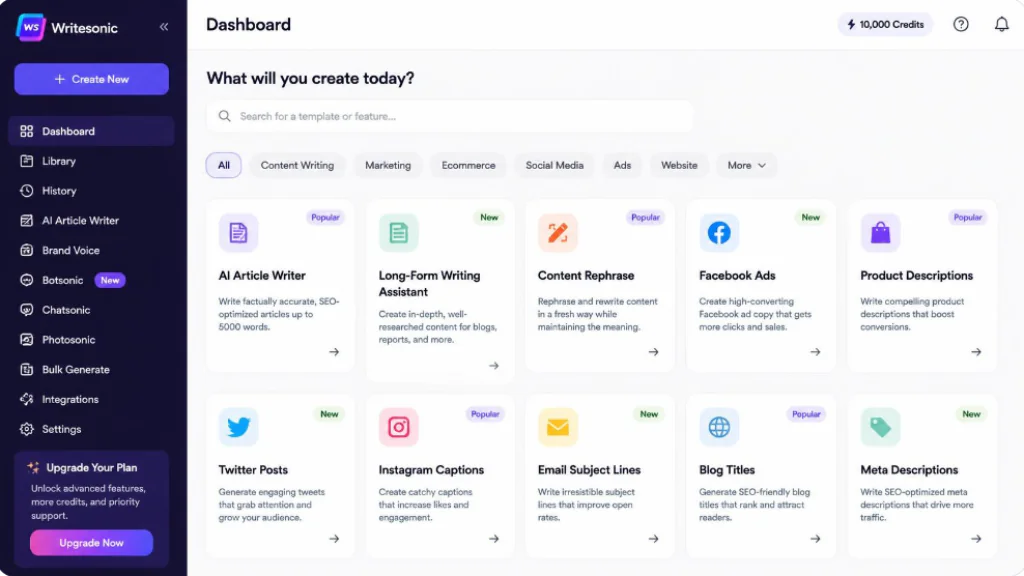
At its core, the suite includes the AI Article Writer for long-form drafts, Chatsonic as a conversational research and writing assistant, an SEO Checker & Optimizer for on-page fixes, and a GEO/visibility module. Multiple underlying AI models are available depending on the plan, which lets teams switch between different writing styles and reasoning strengths without leaving the dashboard.
Key Features Worth Knowing
AI Article Writer 6.0
This is the flagship feature and the reason most buyers try Writesonic in the first place. It pulls in real-time research data while drafting, which helps reduce (though not eliminate) factual drift compared to models writing purely from training data. Keyword workflows, tone settings, and outline controls are built directly into the editor, so a writer can go from a target keyword to a structured draft without switching tools.
Chatsonic and Brand Voice Training
Chatsonic functions as an in-platform research and drafting chat, useful for outlining, brainstorming angles, or rewriting sections without leaving the article editor. Brand voice training lets teams feed in sample content so future drafts trend closer to an established tone — in practice it narrows the gap but rarely removes the need for a human editing pass, especially for nuanced or highly regulated brand voices.
SEO Checker and GEO Visibility Tracking
The built-in SEO Checker scores drafts against on-page factors and suggests fixes as you write, which is genuinely convenient for teams without a dedicated SEO specialist. The GEO module is the more distinctive addition: it monitors whether and how a brand is being cited inside AI-generated answers, a capability still uncommon among general AI writing tools. It’s a real differentiator, though it’s not yet a substitute for dedicated technical SEO platforms handling backlink analysis or deep site audits.
Writesonic Pricing Plans Explained
How the Tiers Break Down
Writesonic’s pricing has shifted more than once as the product repositioned around SEO and GEO, so always confirm current numbers on the official pricing page before purchasing. As of 2026, the general shape of the plans looks roughly like this:
| Plan | Approx. Price | Best For |
| Free / Trial | $0/mo | Testing core writing features with limited usage caps |
| Starter / Standard | ~$79–$99/mo | Freelancers and solo marketers needing steady output |
| Basic / Mid-tier | ~$199–$249/mo | Small teams needing more articles and audits |
| Growth | ~$399–$499/mo | Agencies scaling content plus GEO tracking |
| Enterprise / Agency | Custom | Large teams needing seats, SLAs, and integrations |

Is the Price Justified?
Compared to hiring writers, editors, and a separate SEO tool, Writesonic’s mid-tier plans can pay for themselves quickly for teams publishing regularly. However, entry-level competitors like Copy.ai and Jasper start cheaper, so the value case for Writesonic rests heavily on whether you’ll actually use the SEO and GEO modules — not just the writer.
Writesonic Review: Pros and Cons at a Glance
- Bundled workflow: Combines drafting, on-page SEO, and AI-search visibility tracking in a single dashboard.
- Real-time research: The Article Writer references live data rather than relying solely on static training knowledge.
- Model flexibility: Access to several underlying AI models without separate subscriptions.
- GEO tracking: One of the few tools tracking brand presence inside AI-generated answers, not just Google rankings.
- Multilingual output: Supports drafting and localization across many languages for global content teams.
- Not publish-ready out of the box: AI drafts still need a human editing pass for accuracy, nuance, and brand consistency.
- Aggressive price jumps between tiers: Moving from Starter to Growth involves a steep multiple, not a gradual step-up.
- Article limits on entry plans: Article caps on lower tiers feel tight for teams publishing at real volume.
- General AI writing is not best-in-class: General-purpose writing and workflow automation lag behind dedicated tools like Jasper or Copy.ai.
Who Should Actually Use Writesonic
A Strong Fit For
- Solo marketers and founders: Producing consistent first drafts without a full writing staff.
- Small content teams: Publishing regularly and needing SEO checks without a separate tool.
- Teams exploring GEO: Curious how their brand shows up in AI-generated answers, not just search rankings.
A Weaker Fit For
- Enterprises needing strict brand governance: Teams expecting fully publish-ready copy with minimal editing.
- Pure long-form writing shops: Buyers who only want a writing tool may find dedicated writers like Jasper more focused.
- Advanced technical SEO needs: Teams needing backlink analysis and technical audits will still need a dedicated SEO suite.
Writesonic vs. the Alternatives
Writesonic vs. Jasper
Jasper generally offers stronger brand voice controls and a more polished writing experience, but it doesn’t bundle GEO visibility tracking the way Writesonic does. Teams prioritizing writing quality alone may prefer Jasper; teams wanting SEO and AI-search monitoring in the same tool lean toward Writesonic.
Writesonic vs. Copy.ai
Copy.ai leans harder into workflow automation for go-to-market teams, while Writesonic focuses more on long-form SEO content and visibility tracking. The right choice depends on whether your priority is automating marketing operations or scaling article production.
Writesonic vs. Frase
Frase is built specifically around content optimization scoring against top-ranking pages, which makes it a strong pick for pure SEO content briefs. Writesonic’s advantage is breadth — writing, SEO, and GEO in one subscription — at the cost of being less specialized in any single area.
Final Verdict
Writesonic earns its place as one of the more complete AI content platforms on the market in 2026, particularly for solo marketers and small teams that want drafting, SEO checks, and AI-search visibility tracking without juggling three separate subscriptions. It’s a weaker fit if you need fully polished, publish-ready copy straight out of the editor, or if you already have dedicated SEO tooling and just need a best-in-class writer. Weigh the pricing tiers carefully — the jump from entry to mid-tier plans is steep — and pilot the free or entry plan against your actual editorial workflow before committing to an annual contract.
Related articles:
Writesonic Guide: How to Write a 2,000-Word SEO Article in 5 Minutes
How to Train Jasper AI’s Brand Voice in 10 Minutes (So Your Content Doesn’t Sound Like a Robot)